
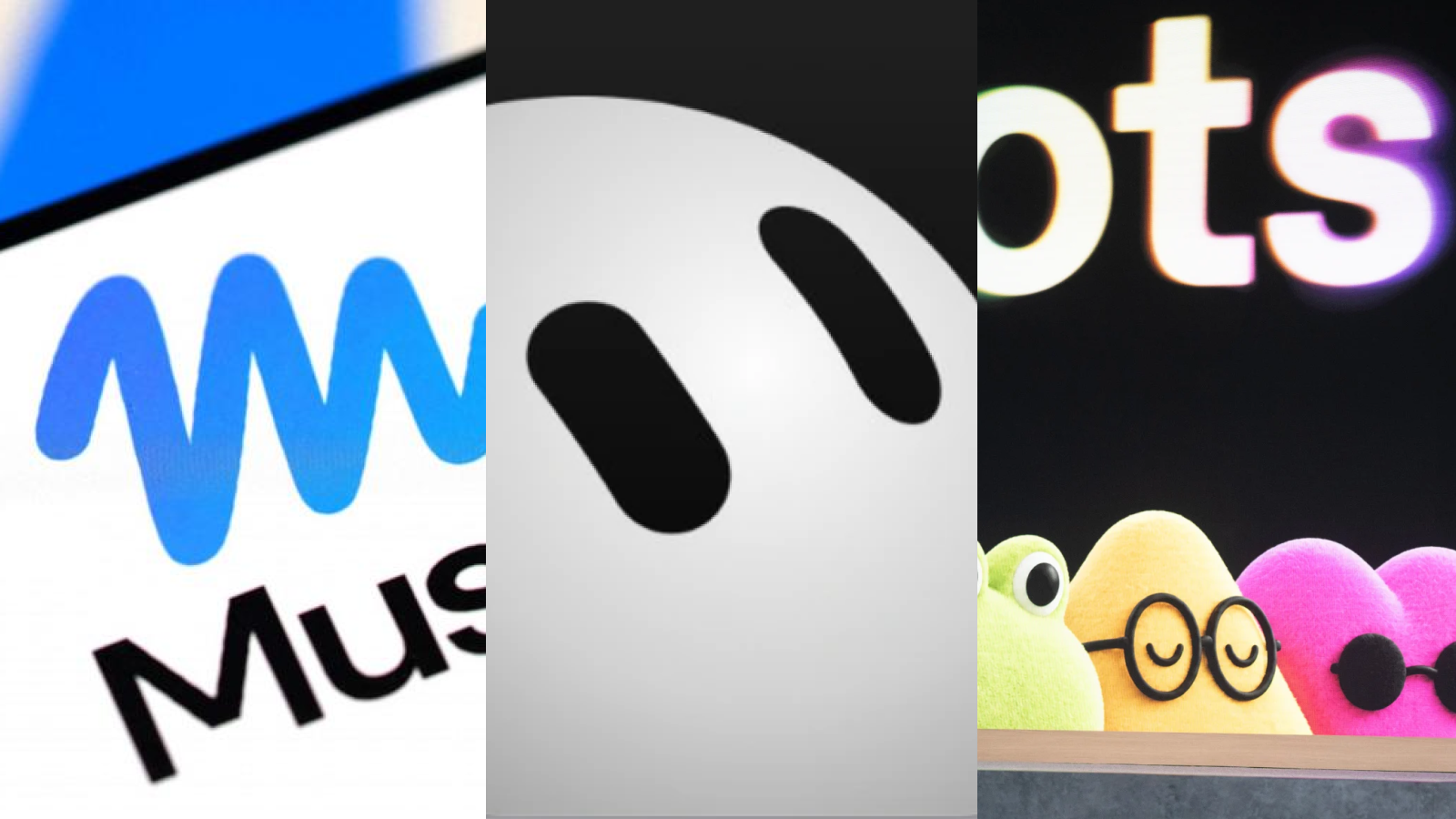
Three AI labs shipped three different bets on "the agent" in the same three-week window this autumn, and none of them agree on what that word should mean. Meta pushed Muse, a personal AI companion app, straight into the hands of a billion-plus users through its own feed. xAI pushed Grok 4.7, a raw capability upgrade aimed at developers and coding workflows. OpenAI pushed Dots, a set of autonomous background workers buried inside ChatGPT's Pro tier. Same word on three very different products; worth pulling apart before the hype settles.
Muse launched on September 8 and crossed 900,000 downloads inside six days, then kept climbing past 3.4 million by the end of the month, topping both the App Store and Google Play. Day-over-day growth hit 55% in its first two weeks, more than double ChatGPT's 24% rate during its own early mobile launch. The app bundles a video-chat avatar, computer-use on Mac, a dedicated email address, and shopping assistance, with smart glasses integration promised next. Meta didn't leave that growth to chance: house ads went live across Facebook, Instagram, and WhatsApp the day after launch, Muse became a top-10 brand by ad spend within weeks, and the push later spread to Reddit, TikTok, and YouTube. Even so, paid placements account for only 6% of impressions; most of the growth is organic, and daily active users jumped another 27% after Meta Connect. On September 29, Meta extended the product into Muse for Small Business, signalling this is a platform play, not a side experiment.
Grok 4.7 landed on September 21 and made its case in specs, not surfaces: a 500,000-token context window, enough to hold an entire codebase or a lengthy document in a single prompt, alongside text and image input and a pitch squarely aimed at coding, agentic tasks, and knowledge work. Pricing held steady at $2/$6 per million tokens for standard prompts and $4/$12 for longer context, with a faster variant kept exclusive to Cursor and Grok Build. Grokipedia 0.3 shipped on September 30 and resumed autonomous edits that had been paused since April; the model also landed on Google's Enterprise Agent Platform through a Gemini Enterprise integration, an odd but real bit of cross-platform placement for a product built by a competitor. It's accessible free through X via @Bot. There's no new agent interface here, no sandbox, no status log; the upgrade is capability, full stop.
Dots is the quietest of the three and the most structurally careful. Each Dot is an autonomous agent that works toward a goal a user sets and keeps working between conversations, surfacing only when it needs permission or attention; status reads as in progress, scheduled, or completed. Typical jobs are things like a morning calendar report or a sweep through connected apps. It's powered by GPT-6, integrates with Slack and Teams with SMS support on the way, and every Dot runs inside its own isolated cloud computer and browser rather than reaching into the user's own device, with built-in monitoring that can pause a Dot if it detects a malicious instruction. It's available to Pro and Business Premium subscribers at no extra cost, and only the goal-pursuit work counts against usage limits; ordinary chats with a Dot stay free.
Run these three through the test we apply to every agent feature we critique: does it show its reasoning, can a user undo it, and are its permissions scoped to the job. Dots comes closest to passing on all three; the sandboxing and the visible status labels are exactly the pattern that separates a trustworthy agent from a gimmick. Muse's download chart is genuinely impressive, and the 6% ad-impression figure suggests real organic pull rather than a manufactured spike, but nothing in the public rollout speaks to how visibly it reasons or how easily a user can walk back a shopping action taken on their behalf; distribution muscle and earned trust are not the same thing, and Meta's own ad spend makes it hard to separate the two this early. Grok 4.7 doesn't even attempt a trust story; it's a specs release wearing the word "agentic" as a label, not a UX decision. That's not necessarily a flaw if you're the developer who just wants a bigger context window, but it's worth naming plainly: a context window is not a control surface.
For a small team shipping its own agent feature this quarter, the lesson isn't to chase any one of these. It's to borrow selectively. Copy Dots' pattern if your agent touches anything with real consequences: a sandboxed environment, a visible status, a pause button that actually pauses. Don't mistake a growth curve like Muse's for proof that users trust what the product is doing; a big platform can manufacture attention faster than it can earn confidence, and a five-person team doesn't have that luxury to fall back on. And if you're tempted to headline a feature with a spec, the way Grok 4.7 headlines its context window, pair it with at least one sentence on what the user can see and control, or you're shipping capability without shipping trust.
One honest caveat, the same one we attach to every critique on this list: all three of these are launch-week pictures of companies that ship weekly. Meta has already added features to Muse since its initial release; xAI announced speed improvements for Grok on October 1 with no benchmarks attached; OpenAI's SMS integration for Dots hasn't landed yet. Treat the detail here as a snapshot, not a verdict, and expect this category to look different by the time you read it.
What's actually new this month isn't that AI agents exist; it's that three different visions of what an agent should be are now live, funded, and competing for the same builders' attention at once. The one that wins long-term won't be the one with the biggest launch budget. It'll be the one that keeps showing its work after the download numbers stop being the story.
Get the drop before everyone else.
Join the waitlist for critiques, feature breakdowns, and build notes straight to your inbox.
Want the full session recordings and the before/after? Get in touch and we'll walk you through it.
← Back to all articles